Why investors may want to consider India?

The mantra is always ‘it’s not about timing the market, it’s about time in the market’. And for good reason. Less experienced investors can be swept up in the noise and end up investing in a company or strategy closer to its peak than a trough.

There are, however, periods when an investment case is particularly strengthened. We would argue that the current structural and economic backdrop supports a long-term investment case for Indian equities.

A structural growth advantage

India’s population profile points to sustained economic expansion. Now the most populous country in the world, the median age in India is 28.4 years compared with China’s 38.4 years[1].

India’s youth is the engine behind its multi-decade growth trajectory, which is being driven by rising consumption, urbanisation and digitalisation.

This is reflected in its GDP growth, which rose 9.2% in 2023, 6.5% in 2024 and is forecast to hit 6.6% in 2025, according to the International Monetary Fund (IMF). Compare this with developed markets such as the US and the EU, which are on course to deliver 2% and 1.4% next year, respectively[2].

Tailwinds and momentum

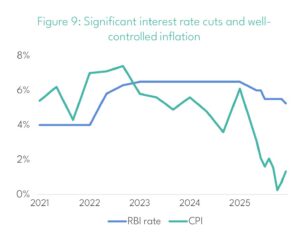
Several tailwinds emerged during 2025, including the Reserve Bank of India (RBI) cutting interest rates by 125bps to 5.25%. Cuts were also made to income tax and the goods and services (GST) tax[3], and inflation reached a multi-year low (0.25% in October, year on year).

S&P upgraded India’s sovereign credit rating to BBB in August 2025, marking the country’s first upgrade since 2007[4].

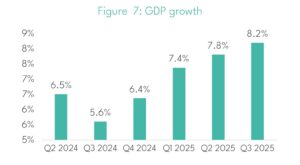
Third quarter GDP growth emphatically beat expectations, delivering 8.2% ahead of the predicted 7-7.5%. It follows stronger than anticipated growth of 7.8% in Q2 and 7.4% in Q1[5], putting the economy on course to exceed the IMF’s 6.6% forecast for 2025.

In a further development, long awaited labour laws were enacted in late November reducing 29 federal laws to just four simplified codes. As a result, instead of 1,400 labour governance rules, companies will now only need to comply with around 350. The regulatory burden on businesses has also been lightened, with the number of forms companies are required to complete reduced to 73 from 180[6].

Additionally, India’s historical valuation premium has narrowed significantly compared with other emerging markets, which creates a more attractive entry point[7].

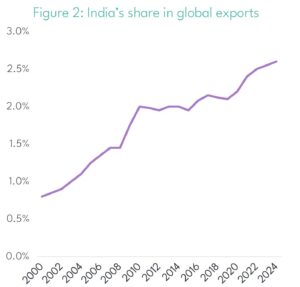
The Indian stock market has had a challenging run in 2025[8]. Companies saw earnings downgrades; despite the economy being well-insulated from Trump’s tariffs due to the US representing such a small percentage of total Indian exports[9].

But sentiment is improving. The government’s reformist zeal has returned, the earnings downgrade period is over and the rhetoric around tariffs has softened. As a result, expectations are rising ahead of 2026[10].

Out of index opportunities

India’s equity universe is one of the broadest and most diverse. Its two primary stock exchanges, the Bombay Stock Exchange (BSE) and the National Stock Exchange of India (NSE), collectively host around 7,700 companies[11]. Yet the most widely tracked indices represent a fraction of this opportunity. The narrower indices cover <0.4% and the broader benchmarks <6.5% of listed names.

This creates significant scope for active managers to uncover mispriced securities that currently sit outside of the indices.

Indian equities also exhibit low correlation when compared with global indices, such as the S&P 500 (0.18) and MSCI World (0.30)[12]. The benefit this offers investors is lower overall portfolio volatility when combined with developed market exposures.

In short, we believe India combines scale, diversity and inefficiency, making it one of the most compelling markets, globally, for active stock selection.

How Alquity India is positioned to capture this opportunity

An experienced team: Our investment team has worked together for six years. It is led by Mike Sell, who has 30 years’ experience of investing in India.

Distinct portfolio construction: We focus on structural themes, such as digitalisation and domestic consumption. Approximately, half of our holdings sit outside the main index, as our team targets under-researched small and mid-cap companies as a differentiated source of alpha.

Governance: Our team seeks companies with high governance standards, and we avoid sectors that have demonstrated misalignment with minority shareholders[13].

Proven track record: Over 10 years, the Fund (I share class, USD) has delivered a 150.5% cumulative return, ranking in the 1st quartile and 14th percentile within the Lipper Global Equity India peer group, outperforming 86% of comparable funds. The Fund exceeded the India Index (+145.4%), the peer group average (+140.8%), and significantly outpaced major ETF alternatives such, as the India iShares ETF (+113.0%)[14], whose returns reflect the provisioning for capital gains tax – a drag not applied to the index but accrued by the Alquity India Fund.

The performance shown is based on the I class charging structure with an OCF of 1.0%. We have used the track record for the USD M class since 30th April 2014 and the USD Y class since 29th June 2017 and added back 1% per annum up until the launch of its GBP I class (12th November 2019) and converted to USD up until 13th August 2024 when the share class was launched. Actual results will vary from the analysis. Past performance should not be taken as an indication or guarantee of future performance, and no representation or warranty, expressed or implied is made regarding future performance. Currency exchange rate movements can lead to an increase or decrease in the value of the fund’s investments.


SOURCES:

[1] Source: United Nations, January 2023

[2] Source: IMF, October 2024

[3] Source: RBI, Bloomberg, October 2025

[4] Source: S&P Global, August 2025

[5] Source: Financial Times, November 2025

[6] Source: BBC, November 2025

[7] Source: Bloomberg, October 2025

[8] Source: Bloomberg,

[9] Source, Bloomberg, November 2025

[10] Source, Bloomberg, November 2025

[11] Source: NSE and BSE

[12] Source: Bloomberg, September 2025

[13] Source: Alquity, November 2025

[14] Source: Alquity, Bloomberg, Lipper, as of 31st October 2025.


India: A stock picker’s market

Few investors realise that India is home to the oldest stock exchange in Asia. Founded in 1875, the BSE (also known as the Bombay Stock Exchange) is the tenth oldest in the world.
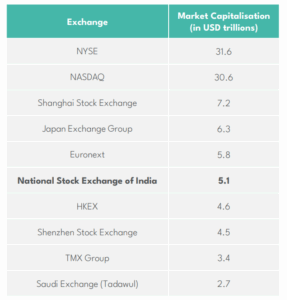
The National Stock Exchange of India (NSE) was incorporated in 1992. Trading began in 1994, with it later becoming the country’s pre-eminent stock exchange. Its market cap reached $5.1 trillion as of the end of 2024, placing it among the 10 largest stock exchanges globally.
Between them, the BSE and NSE are home to roughly 7,700 companies.
When it comes to selecting names for a portfolio, many investors opt to stick to an index. To put that into context, some of the most well-known Indian equity indices consist of between 30 and 500 names. This means the index at lower end of that range is comprised of less than 0.4% of all listed Indian companies, while the index at the upper end represents less than 6.5%.

For Mike Sell, Head of Global Emerging Market Equities, indices can be useful tools. “There are numerous index providers which provide a really useful service to investors. That work is not to be underestimated or undervalued. But indices are a tool, not a panacea. There are huge numbers of companies that are not included in the main Indian indices that should not be ignored by investors,” he adds. “The opportunity set is vast, especially for companies in the small to mid-cap range, which is why it can be hugely rewarding for investors to look beyond the obvious and venture outside the confines of a predetermined list.”
Among the limitations of sticking solely to an index is their tendency to reflect the more traditional industries of the past.

About half of the holdings in the Alquity Indian Subcontinent Fund are not in the main Indian indices. For Mike “it’s about using rigorous fundamental analysis and a disciplined investment approach to uncover hidden gems”.

WHAT MAKES A STOCK PICKER’S PARADISE?

The goal of any active manager is to identify mispriced securities that have the potential to deliver higher returns than the market, thereby generating better returns for investors.
One of the hallmarks of a good stock-picking environment is a resilient macro backdrop — where the economy is stable enough for company fundamentals to drive performance. “And this is the case with India… For example, it was well insulated against the tariffs announced by Donald Trump in early 2025, as such a small proportion of GDP is linked to US exports.”
“No country is entirely isolated from what is happening in the wider world; but a strong economy that is driven primarily by domestic, rather than global, factors creates a rich seam of opportunity for active managers”.

LEADERS AND LAGGARDS

Beyond a lower level of sensitivity to external forces, high return dispersion is also a core feature of a good stock picking market. A wide range of returns within a market increases the potential for active managers to pick winners and avoid laggards.
For Mike, this is where a robust investment process is vital. “It’s important to analyse why a particular company could outperform its peers. There will be several reasons for this; but the important thing to understand is whether it has stable and repeatable growth.”

OUT OF SYNC

Another key feature of a stock picker’s market is low correlation, where individual stock performance is driven less by broader, global macroeconomic factors, and more by company-specific fundamentals.
“Macroeconomic developments will always impact companies… There is no getting away from that. No active manager can, or should, ignore what is happening in the wider economy; but, to a greater or lesser extent, things such as changes to government policies will generally affect companies in similar ways.”

FUTURE WINNERS

True active managers, skilled stock pickers, relish markets that demonstrate high dispersion and low correlation because they are more likely to find mispriced opportunities.
“As an active manager, part of my drive, my passion for my work, is finding strongly growing and well-managed companies that have not yet been recognised. And India is a fantastic market in which to do that.”
“It’s size and scale are increasingly becoming recognised. It has one of the strongest predicted GDP growth rates in the world, according to the IMF. It has an ambitious government that has implemented a lot of business-positive reform over the past few years.”
The indices provide a snapshot of today’s winners. What the Alquity team is looking for is tomorrow’s winners.


SOURCES:

BSE, as of 2025, World Federation of Exchanges (as of 15th May 2025), BSE (as of 10th November 2025): NSE, as of March 2025, IMF, as of October 2025


India vs China: Where is the best opportunity now?

The webinar, hosted by Mike Sell, focused on Emerging Markets with a particular emphasis on China and India. Mike highlighted recent market performance, noting that India has lagged behind other Emerging Maarkets, while China and South Korea have shown stronger gains YTD. Key drivers of India’s underperformance included tariffs concerns and economic growth, but these issues are now easing.

For China, the recovery is gradual, with slowing consumer confidence, retail, and property sales, though the country remains a major manufacturing hub despite of US tariffs. In addition, broader Emerging Markets offer diverse opportunities, including structural growth themes like digitalisation, domestic retail, travel and e-commerce, such as our holdings in Jago (Indonesia), Fourlis (Greece), Air Astana (Kazakhstan), and SEA (Southeast Asia).

India’s investment case is both structural and supported by cyclical tailwinds: GDP growth has accelerated, inflation and interest rates are low, tax cuts and a good monsoon support consumption, and foreign investment is increasing. India’s growth is largely domestic, giving low correlation with developed markets and supporting a big, liquid equity market.

Watch the replay here:

Disclaimer: 

This marketing communication is issued by Alquity Investment Management Limited (“AIML”) for distribution both within and outside the United Kingdom. AIML is incorporated in England and Wales (Company No. 07992381) and is authorised and regulated by the Financial Conduct Authority (FRN 463991). Its registered office is Audrey House, Ely Place, London, EC1N 6SN. This material is for distribution to Professional Clients only, as defined under the Financial Conduct Authority’s (“FCA”) conduct of business rules, and should not be relied upon by any other persons. The Alquity Asia Fund, Alquity Future World Fund, Alquity Indian Subcontinent Fund and Alquity Global Impact Fund are sub-funds of the Alquity SICAV (the “Fund”), which is a UCITS-compliant investment vehicle and a recognised collective investment scheme under the Financial Services and Markets Act 2000 (FSMA) in the United Kingdom. The Alquity SICAV is an open-ended investment company managed by Limestone Platform incorporated under the laws of Luxembourg and authorised by the Commission de Surveillance du Secteur Financier (CSSF). The Fund is authorised under the UCITS Directive (Directive 2009/65/EC). Sub-funds may not be registered for distribution in all jurisdictions. Alquity Investment Management Limited acts as the investment manager to the SICAV.
The information in this document (this “Document”) is for discussion purposes only. This Document does not constitute an offer to sell, or a solicitation of an offer to acquire, an investment (an “Interest”) in any of the funds discussed herein. This Document is not intended to be, nor should it be construed or used as, investment, tax or legal advice. This Document does not constitute any recommendation or opinion regarding the appropriateness or suitability of an Interest for any prospective investor. This material is for distribution to Professional Clients only, as defined under the Financial Conduct Authority’s (“FCA”) conduct of business rules, and should not be relied upon by any other persons.
This Document may not be reproduced in whole or in part, and may not be delivered to any person (other than an authorised recipient’s professional advisors under customary undertakings of confidentiality) without the prior written consent of the Investment Manager.
This Document is qualified in its entirety by the information contained in the Fund’s prospectus and other operative documents (collectively, the “Offering Documents”). Any offer or solicitation may be made only by the delivery of the Offering Documents. Before making an investment decision with respect to the Fund, prospective investors are advised to read the Offering Documents carefully, which contains important information, including a description of the Fund’s risks, conflicts of interest, investment programme, fees, expenses, redemption/withdrawal limitations, standard of care and exculpation, etc. Prospective investors should also consult with their tax and financial advisors as well as legal counsel. This Document does not take into account the particular investment objectives, restrictions, or financial, legal or tax situation of any specific prospective investor, and an investment in the Fund may not be suitable for many prospective investors. An investment in the Fund is speculative and involves a high degree of risk. The Fund’s investment approach is long-term, investors must expect to be committed to the Fund for an extended period of time (3-5 years) in order for it to have an optimal chance of achieving its investment objectives.


Building India’s Future

APL Apollo: Building India, one tube at a time

APL Apollo is more than a steel tubes manufacturer; it plays a key role in India’s infrastructure growth. The company produces pre-engineered steel tubes and structures that are lighter and more cost-effective than traditional concrete and brick construction. This industrial efficiency translates directly into social impact: schools, hospitals, warehouses and metros are built around 40% faster while cheaper, expanding access to education, healthcare and economic activity across Tier 2 and Tier 3 cities. By reducing material waste and enabling modular construction, APL Apollo also addresses environmental sustainability (a key consideration in long-term urban development). Modular steel construction reduces raw material intensity and supports recycling, while economic development occurs naturally through job creation at plants and construction projects. According to a study from the University of Hong Kong, modular steel construction can result in an approximate 46% reduction in waste when compared to conventional methods.
The company’s products form part of the backbone of New India’s industrial and urban ecosystems, showing that long-term profitability can coexist with social and environmental benefits.

Cholamandalam: Financial inclusion as a growth engine

Cholamandalam, a long-standing holding in our Indian portfolio, exemplifies how financial services can drive real social mobility. Unlike traditional banks, which historically often focus on large corporates, Chola targets the unbanked segments of India’s economy, such as small vehicle fleet operators, rural entrepreneurs and informal business owners. Vehicle loans, small-business credit and structured financing enable these individuals to grow their businesses, increase income and provide employment in their communities. For example, a single truck loan can transform a family business into a multi-employee operation, connecting villages to markets and enabling rural economic growth. By extending formal credit to these segments, Chola helps reduce borrowers’ reliance (and vulnerability) on informal money-lenders that often charge exorbitant interest rates (up to ten times higher), a common obstacle to small-business growth in rural India, as pointed out by the Reserve Bank of India.
Sustainability is embedded in Chola’s approach through responsible lending: products are designed to enhance borrowers’ livelihoods rather than create debt traps. Chola exemplifies how capital deployment can directly empower communities while maintaining a healthy and consistent growth track record.

Aptus Value Housing Finance: Housing finance delivering social benefits

Aptus, a fast growing name in our portfolios, illustrates how financial services can deliver social benefits in the housing sector. While other lenders tend to focus on higher salaried, urban borrowers, Aptus goes deeper into the Indian “underserved” economy, such as self employed individuals in rural and semi urban markets, and first time homeowners and households in Tier 2 and Tier 3 cities (which are considered by other lenders as high-risk segments. Despite the higher perceived risk, Aptus’s discipline and underwriting practices are reflected in very low non-performing assets that are well below industry averages, indicating the company’s resilience and risk management.
Aptus’ product offering (housing loans for self construction, home improvement and refurbishment, extensions, etc.) helps families move from informal cash credit (which can carry onerous interest rates of up to 60% annually) or lack of financing into secure, asset backed borrowing. By doing this, Aptus supports wealth creation (as a home is often a family’s largest asset) and improves living standards, so that families are not stuck in inadequate dwellings which are widely common in rural India.

Sources: Wei Pan and Zhiqian Zhang, as of 15th January 2023, 2 Reserve Bank of India’s report on currency and Finance as of August 2024.

Disclaimer: 

This marketing communication is issued by Alquity Investment Management Limited (“AIML”) for distribution both within and outside the United Kingdom. AIML is incorporated in England and Wales (Company No. 07992381) and is authorised and regulated by the Financial Conduct Authority (FRN 463991). Its registered office is Audrey House, Ely Place, London, EC1N 6SN. This material is for distribution to Professional Clients only, as defined under the Financial Conduct Authority’s (“FCA”) conduct of business rules, and should not be relied upon by any other persons. The Alquity Asia Fund, Alquity Future World Fund, Alquity Indian Subcontinent Fund and Alquity Global Impact Fund are sub-funds of the Alquity SICAV (the “Fund”), which is a UCITS-compliant investment vehicle and a recognised collective investment scheme under the Financial Services and Markets Act 2000 (FSMA) in the United Kingdom. The Alquity SICAV is an open-ended investment company managed by Limestone Platform incorporated under the laws of Luxembourg and authorised by the Commission de Surveillance du Secteur Financier (CSSF). The Fund is authorised under the UCITS Directive (Directive 2009/65/EC). Sub-funds may not be registered for distribution in all jurisdictions. Alquity Investment Management Limited acts as the investment manager to the SICAV.
The information in this document (this “Document”) is for discussion purposes only. This Document does not constitute an offer to sell, or a solicitation of an offer to acquire, an investment (an “Interest”) in any of the funds discussed herein. This Document is not intended to be, nor should it be construed or used as, investment, tax or legal advice. This Document does not constitute any recommendation or opinion regarding the appropriateness or suitability of an Interest for any prospective investor. This material is for distribution to Professional Clients only, as defined under the Financial Conduct Authority’s (“FCA”) conduct of business rules, and should not be relied upon by any other persons.
This Document may not be reproduced in whole or in part, and may not be delivered to any person (other than an authorised recipient’s professional advisors under customary undertakings of confidentiality) without the prior written consent of the Investment Manager.
This Document is qualified in its entirety by the information contained in the Fund’s prospectus and other operative documents (collectively, the “Offering Documents”). Any offer or solicitation may be made only by the delivery of the Offering Documents. Before making an investment decision with respect to the Fund, prospective investors are advised to read the Offering Documents carefully, which contains important information, including a description of the Fund’s risks, conflicts of interest, investment programme, fees, expenses, redemption/withdrawal limitations, standard of care and exculpation, etc. Prospective investors should also consult with their tax and financial advisors as well as legal counsel. This Document does not take into account the particular investment objectives, restrictions, or financial, legal or tax situation of any specific prospective investor, and an investment in the Fund may not be suitable for many prospective investors. An investment in the Fund is speculative and involves a high degree of risk. The Fund’s investment approach is long-term, investors must expect to be committed to the Fund for an extended period of time (3-5 years) in order for it to have an optimal chance of achieving its investment objectives.


India: the disconnect between fundamentals and the market

The performance of the Indian stock market has recently been lacklustre. This is despite a significant improvement in the economic environment, with 100bp of interest rate cuts in 2025 (to 5.5%) and significant cuts in income tax in the February budget followed by the recent rationalisation and reduction of the Goods and Service Tax. This is in addition to continued elevated spending on infrastructure, and a further successful monsoon (with rainfall 108% of the long run average) which will boost the rural economy.  Inflation remains low (2.1% year on year in August) and foreign exchange reserves remain robust ($700.2bn as at 26th September).

So, why the subdued performance?  We ascribe this to 3 factors:

  1. Earlier concerns about a weakening growth environment: with Q3 2024 GDP reported at just 5.4%. This was due to a number of one-off factors, and does not represent the underlying growth dynamic as evidenced by subsequent GDP growth in the first two quarters of 2025 of 7.4-7.8%. These stronger prints are prior to the impact of the interest rate and tax cuts, and thus we expect a strong upcoming Festival and Wedding season. Indeed, the Reserve Bank of India revised up their expectations for GDP in their October 2025 policy meeting, and gross foreign direct investment rose 33% in the first four months of this fiscal year to an all-time high for that period of $37.7bn.
  2. Geopolitical noise following Trump’s tariff imposition on India. In our view, this is largely irrelevant as exports to the US represent just 2.5% of Indian GDP and India’s circa 7.5%+ GDP is driven by domestic structural growth (such as urbanisation and the shift to the organised sector), in stark contrast to China’s export driven economy.
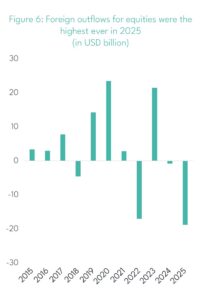
  3. A switch to alternative investment destinations. AI-related stocks have driven strong performance in markets such as Taiwan, as well as also having a significant influence on the performance of China and Korea. We believe that a reduction in foreign allocations to India has partly funded that switch. However, domestic investors continue to add to the Indian market (with inflows in July 2025 reaching a 9 month high) which demonstrates their confidence in the outlook for their home market. Furthermore, we do not believe that the Indian story should be seen as a tactical allocation for short term alpha, rather a structural, relatively uncorrelated long-term growth opportunity. We expect that foreign flows will resume to India as investors appreciate the significantly better economic environment and lock-in exceptional profits from elsewhere. Indeed, HSBC upgraded India to an ‘overweight’ last week. Finally, increased interest in Emerging Markets more generally and the resultant inflows into the asset class (which have accelerated in recent weeks) will also benefit India, as the third largest weighting within the universe.

Turning to valuations, which are never ‘cheap’ in terms of an absolute low p/e number, due to the multi-year structural growth opportunity which is not captured in a 1-2 year forward p/e. In addition, India benefits from a high Return on Equity and good corporate governance compared to many other markets. Nevertheless, current p/e valuations have descended back to their 5yr average and p/b valuations are approaching 1 standard deviation below their 5yr average. We believe that these are unjustified given the substantially improved outlook.In conclusion, we believe that the disconnect between the strong and improving fundamentals of the Indian economy and the lacklustre stock market is purely transitory, providing a potential opportunity for the long-term investor.

Source: Alquity, Government of India, JP Morgan, Spark, CLSA, HSBC October 2025

Disclaimer: 

This is not an offering memorandum or prospectus and does not constitute investment advice. This is a marketing communication that is intended for information purposes only. The content, including external data sources, is believed to be reliable but no assurances or warranties are given. The companies mentioned are shown for illustrative purposes only, do not constitute investment advice, and are not a recommendation to buy or sell any security.
Investments in emerging markets, including India, involve greater risks, including political, currency, and liquidity risks.
Prospective investors should read and understand the terms of the Prospectus (including the risk factors) prior to purchasing units in any of the funds. There can be no assurance that the fund’s investment objectives will be achieved and investment results may vary substantially over time. We do not provide financial, tax or legal advice and we recommend that you obtain your own independent advice tailored to your individual circumstances prior to investing. Prospective investors should be aware that the value of
investments can go down as well as up and past performance is not an indicator of future performance. Investors should be aware that by investing in the fund, they risk losing all or part of the capital invested. The Alquity Asia Fund, Alquity Future World Fund, Alquity Indian Subcontinent Fund and Alquity Global Impact Fund are sub-funds of the Alquity SICAV (the “Fund”), which is a UCITS-compliant investment vehicle and a recognised collective investment scheme under the Financial Services and Markets Act 2000 (FSMA) in the United Kingdom.
The Alquity SICAV is an open-ended investment company managed by Limestone Platform incorporated under the laws of Luxembourg and authorised by the Commission de Surveillance du Secteur Financier
(CSSF). The Fund is authorised under the UCITS Directive (Directive 2009/65/EC). Sub-funds may not be registered for distribution in all jurisdictions. Alquity Investment Management Limited acts as the investment manager to the SICAV.
This marketing communication is issued by Alquity Investment Management Limited (“AIML”) for distribution both within and outside the United Kingdom. AIML is incorporated in England and Wales (Company No. 07992381) and is authorised and regulated by the Financial Conduct Authority (FRN 463991). Its registered office is Audrey House, Ely Place, London, EC1N 6SN.


Capturing the spirit of entrepreneurial India (September 2025)

In our latest webinar, Mike explores:

  • How India’s entrepreneurial drive is reshaping investment opportunities

  • The overlooked market segments powering Alquity’s differentiated portfolio approach

  • The latest economic and portfolio update straight from the desk of the fund manager

You can watch the webinar here:

And you can download the slides here: https://alquity.com/wp-content/uploads/2025/08/Alquity-India-Webinar-September-2025.pdf


Why India?

It’s one of the biggest economies in the world, has one of the strongest projected GDP growth rates and is home to the largest population on Earth. Despite these credentials, it’s fair to say, at best, most investors have limited exposure to India. 

Investors have long believed that putting their money to work in an emerging market or Asia fund is enough, but India is experiencing multiple tailwinds that are propelling its global ascendency and those with purely token exposure ought to reconsider.  

For many years there has been talk that the 21st century will be India’s century, just as the 20th proved to be America’s, and the 19th is considered Britain’s. Whether this comes to pass or not, there remain many reasons investors need to be paying more attention to India.  

India = growth 

First and foremost, India is a growth story. In mid-2025, India became the world’s fourth largest economy after its GDP nudged ahead of Japan’s (see Table 1), according to the International Monetary Fund (IMF)(1) 

By the end of this decade, the IMF is projecting that India will overtake Germany to become the third largest economy in the world, as it is on course to hit $6.77trn by 2030, compared with Germany’s forecast of $5.58trn(2). 

Table 1

India is projected to achieve real GDP growth of 6.2% in 2025(4), which is the strongest among the countries listed in Table 1. Its closest competitor is China, which is forecast to achieve 4% growth(5) 

Seven of the top 10 economies are on course to grow between 0.4% and 2% in 2025. The only outlier is Germany, which is not expected to record any real GDP growth(6) 

India = ambition 

In addition to the positive and improving economic outlook, Prime Minister Narendra Modi has outlined a series of ambitious targets. When India marks its centenary of independence in 2047, the goal is that the country will also be able to celebrate its elevation from emerging to developed market.  

As such, in November 2023, his government unveiled Viksit Bharat(7) (Developed India), a declaration of intent to uplift all facets of India’s society and economy. The primary goal is for the country to become self-reliant and prosperous by 2047(8) 

Growth is the game plan. To achieve the government’s ambitious GDP target of $30trn by 2047 – the current size of the US economy – India’s economy needs to grow more than seven-fold over the next two decades. This means, on average, GDP needs to rise by 8-10% every single year.  

The social and economic reforms outlined by the Modi government are expected to be among the primary accelerators of this growth.  

Steps have been announced to improve the ease of doing business in India, as well as greater support for micro, small and medium-sized enterprises (MSMEs) and startups(9) 

Efforts have long been underway to help mostly small and rural businesses transition from the informal to the formal sector, as these companies are recognised as an essential and growing part of the Indian economy.  

A successful transition means companies will be able to access finance and government support, as well as benefit from greater legal and regulatory protections(10). Workers will enjoy legal protections, like a fixed salary; healthcare benefits; paid leave; and retirement savings(11). 

India = demographics  

Equally important are the social reforms Modi’s government has outlined as part of Viksit Bharat. These include zero poverty, female empowerment, quality education and affordable and comprehensive healthcare. 

In April 2023, India’s population reached 1.42bn, surpassing China to become the world’s most populous country. The UN estimates that the number of people in India will peak at around 1.7bn by the 2060s, whereas China’s population has already started to decline(12).   

Importantly, India is home to a lot of young people. According to the US Central Intelligence Agency (CIA), as of 2024, the median age of India’s population was 29.8 years. This compares with 49.9 years for Japan, 46.8 in Germany, 40.2 years in China and 38.9 in the USA(13).   

A young, healthy and well-educated population creates a virtuous circle of growth. It will result in a stronger workforce that is able to take on more high value jobs, which means higher wages, a larger middle class and even greater discretionary spending.  

India = business 

When investing in India, most fund managers turn to the MSCI for ideas and inspiration. Comprised of the large and mid-cap segments of the market, the MSCI India Index is made up of 158 companies, covers 85% of the Indian equity universe and falls into 11 broad sectors (see Chart 1)(14).

Chart 1

Investors, therefore, tend to be largely exposed to India via ETFs and funds that are dominated by large cap companies, which means they miss out on the opportunities available in the small cap space.   

Indexes are also backwards looking, recognising the achievements of the past but not necessarily the growth opportunities of the future.  

Research from McKinsey has identified 18 transformative ‘arenas’ in India (see Table 2) it believes ‘could experience significant growth, technological advancements, and sustained investment dynamics’(16) 

The report stated: “Nine of these are global arenas where Indian companies could attain disproportionate growth through distinctly Indian capabilities. The other nine are what we define as ‘national’ arenas or sectors that could advance long-term strategic interests and fuel growth in a uniquely India-specific context.  

“This mix of global and national arenas could play a pivotal role in realising India’s vision of becoming a developed economy by 2047,” the McKinsey report added(17).    

Table 2

When compared with the (admittedly) broad categories included in the MSCI India Index (see Chart 1), the full extent of opportunities that investors risk missing out on becomes clear.  

And there is no shortage of current and budding entrepreneurs in India. The 2024/25 Global Entrepreneurship Monitor, which assesses national levels of entrepreneurial activity each year, ranked India fifth out of 56 countries(19). It found that 85% of Indians are confident they have the skills or knowledge to start their own business. A similar proportion said they felt it was easy to start a business in India.   

India = opportunity 

Investors often have a myopic view of India. The 158 predominately large caps in the MSCI India Index overshadow the fast-growing and innovative smaller companies that are emerging each year.  

India’s size, scale, population and strong growth don’t seem to generate the same level of international headlines as other countries.  

But there are so many factors at play that all point to a bright future for India. It boasts a strong and growing economy, an increasingly well-educated and healthy population, and strong levels of entrepreneurship. All of this is backed by a stable government that has demonstrated how ambitious it is.  

Investors need to take note. The Indian growth story is far from over.   


Disclaimer: 

This is not an offering memorandum or prospectus and does not constitute investment advice. This is a marketing communication that is intended for information purposes only. The content, including external data sources, is believed to be reliable but no assurances or warranties are given. The companies mentioned are shown for illustrative purposes only, do not constitute investment advice, and are not a recommendation to buy or sell any security.
Investments in emerging markets, including India, involve greater risks, including political, currency, and liquidity risks.
Prospective investors should read and understand the terms of the Prospectus (including the risk factors) prior to purchasing units in any of the funds. There can be no assurance that the fund’s investment objectives will be achieved and investment results may vary substantially over time. We do not provide financial, tax or legal advice and we recommend that you obtain your own independent advice tailored to your individual circumstances prior to investing. Prospective investors should be aware that the value of
investments can go down as well as up and past performance is not an indicator of future performance. Investors should be aware that by investing in the fund, they risk losing all or part of the capital invested. The Alquity Asia Fund, Alquity Future World Fund, Alquity Indian Subcontinent Fund and Alquity Global Impact Fund are sub-funds of the Alquity SICAV (the “Fund”), which is a UCITS-compliant investment vehicle and a recognised collective investment scheme under the Financial Services and Markets Act 2000 (FSMA) in the United Kingdom.
The Alquity SICAV is an open-ended investment company managed by Limestone Platform incorporated under the laws of Luxembourg and authorised by the Commission de Surveillance du Secteur Financier
(CSSF). The Fund is authorised under the UCITS Directive (Directive 2009/65/EC). Sub-funds may not be registered for distribution in all jurisdictions. Alquity Investment Management Limited acts as the investment manager to the SICAV.
This marketing communication is issued by Alquity Investment Management Limited (“AIML”) for distribution both within and outside the United Kingdom. AIML is incorporated in England and Wales (Company No. 07992381) and is authorised and regulated by the Financial Conduct Authority (FRN 463991). Its registered office is Audrey House, Ely Place, London, EC1N 6SN.

Sources:
  1. International Monetary Fund
  2. International Monetary Fund
  3. International Monetary Fund
  4. International Monetary Fund
  5. International Monetary Fund
  6. International Monetary Fund
  7. India’s Journey to Becoming a Global Superpower
  8. Meaning, Vision, Objective, Registration
  9. Bold Vision, Brighter Future
  10. Rethinking Formalization
  11. The Transition of India’s Economy Towards Formalization
  12. Department of Economic and Social Affairs
  13. CIA – Median age
  14. Blackrock – iShares MSCI India UCITS ETF
  15. India’s future arenas: Engines of growth and dynamism
  16. India’s future arenas: Engines of growth and dynamism
  17. India’s future arenas: Engines of growth and dynamism
  18. The so-called Bio-to-X market includes various sectors that exploit biological raw materials, such as biofuels and bioplastics
  19. Global Entrepreneurship Monitor


Beyond the big caps: India’s entrepreneurs are the real growth story

From V-Mart’s Lalit Agarwal, who turned a family tailor shop into a 500-store fashion chain, to ixigo’s Aloke Bajpai and Rajnish Kumar, who built one of India’s leading online travel agencies – these are stories of purpose, resilience and long-term vision.
At Alquity, we believe founder-led companies are a vital part of India’s economy and can offer some of the most dynamic long-term opportunities.
Read now the full article.

The Rise of Domestic Indian Travel

India covers more than 3.2 million sq. km and, home to 1.46 billion people, it officially became the most populous country in the world in 2022. With mountains, deserts, rainforests, plains and plateaus, the Indian peninsula boasts a wealth of natural wonders.

So, it is little surprise that improving infrastructure and a burgeoning middle class are driving domestic travel and tourism.

“India is like a country of 100 countries,” says Mike Sell, Head of Global Emerging Market Equities at Alquity Investment Management. “Leisure travel is a great story and it’s a real standout because its really strong growth has not been impacted by the so-called slowdown seen in other areas of the economy.”

He adds: “People think India has a growth problem, but it really doesn’t. Growth has been a bit weaker, temporarily, but throughout all that the travel sector has gone gangbusters.”

Skin in the game

Within the Alquity Indian Subcontinent Fund, the travel theme is represented via two key sectors: online travel agencies and hotels.

“Everything in life is a cycle, and hotels are a prime example,” Sell says. “If you have lots of hotel supply coming up and not enough demand, prices go down. And vice versa. But you can’t create a hotel overnight and in a very crowded city you can’t create one at all. Hotels have amazing supply and demand fundamentals.”

The fund primarily invests in domestic growth drivers, so the team seeks out homegrown companies that deliver local services.

Lemon Tree Hotels is one of the larger weightings in the fund. The company identified a gap in the market, recognising there were few options for travellers seeking mid-tier and economy accommodation.

Its first hotel, which offered 49 rooms, was opened in 2004 in the city of Gurugram (previously Gurgaon), which lies to the southwest of New Delhi. Today, it has 110+ hotels in over 64 cities across the country, offering circa 10,300 rooms.

Sell says: “As with many of the companies in our portfolio, Lemon Tree is still run by its founder, Patu Keswani, which leads to a greater level of dynamism in decision-making, given Mr Keswani has direct ‘skin in the game’.”

Having listed in 2018, the pandemic proved an early challenge for Lemon Tree. Its share price recovered by late 2021, however, with strong growth recorded in the following years.

The company remains ambitious and, while the team’s interest in them is primarily centred on their domestic growth story, Lemon Tree opened its first international hotel in Dubai in 2019, followed by Bhutan in 2020. More international locations are in the pipeline. By 2028, the company is targeting more than 20,000 rooms across more than 300 hotels.

“Our conviction in the company remains high, given their robust business model geared to the long-term structural growth in the sector, strong barriers to entry and dynamic management,” Sell adds.

Attractive fundamentals not artificial index constructs

The rise in travel is being facilitated by online travel agencies, which also plays into another key theme in the portfolio, internet-enabled companies.

MakeMyTrip is a prime example, offering hotels, flights and holiday bookings via its website. Founded in Gurgaon in 2000, it has been in the Alquity Indian Subcontinent Fund since October 2023.

MakeMyTrip recorded incredibly strong share price growth in recent years. Having listed in 2010, it struggled to break through $40 per share until Q3 2023. The price per share subsequently accelerated through $50 and $100 during the course of 2024.

“As with Lemon Tree Hotels, we are attracted to the multi-year sector dynamics of the travel sector and the comprehensive ‘moat’ surrounding the company,” Sell explains. “Whilst the fact that this company is not included in the major Indian stock market indices may act as a deterrent to certain peers, we are firm believers in focusing on attractive fundamentals rather than artificial index constructs.”

An equally ambitious government

The Indian Government has allocated significant funding in recent years to modernise domestic infrastructure. For the financial year ending March 2024, capital expenditure was nearly 30% higher than in the previous financial year. Compared with four years ago it is 2.8 times higher.

Billions of dollars have been channelled to key areas such as roads, railways[1] and airports. A prime example of this improvement drive is the public-private partnership behind the construction of Navi Mumbai International Airport, meaning India’s second largest city will be served by two international airports from June 2025.

These improvements further catalyse the domestic travel story, as it makes it easier for people to access more far-flung destinations. Especially for shorter, perhaps weekend, trips.

That said, while air travel is an obvious way for people to move around, it is not a sector the Alquity Indian Subcontinent Fund invests in.

“Airlines are problematic because there are more things that can go wrong. They are very sensitive to currency changes, the fuel price and accidents,” says Sell. “We feel there are better ways to play the leisure story.”

As the two examples above clearly demonstrate, there is no lack of ambition or opportunity when it comes to India’s domestic travel sector.

Relatively insulated against tariffs

India is on course to become the world’s third largest economy within the next couple of years. With a growing middle class and rising disposable incomes, average household incomes are expected to increase circa 1.4x between 2020 and 2030.

Backed by strong demographics, a stable government, improving infrastructure and burgeoning domestic growth, India is forecast to deliver GDP growth of circa 6.5% every year until 2029[2].

April witnessed US President Donald Trump unveil a series of, what the White House called, ‘reciprocal tariffs’. While they are a gamechanger for the world economy; India, in many ways, is insulated against much of the turbulence. The tariff rate for India was set at 26%, but exports to the US account for just 2.7% of GDP and they are expected to play little role in future growth.

The companies in the Alquity Indian Subcontinent Fund are largely positioned to benefit from the country’s domestic growth story. The vast majority provide goods and services to local people and, given the size and scale of the country, have ample opportunity to grow domestically, by expanding to new regions and cities.

“In terms of demographics and the size of the opportunity, there are few markets where domestically focused companies are in a more positive position than they are in India,” says Sell.

“The potential of India has been clear throughout my almost three-decade career,” he adds. “This has been unlocked by Modi over the last few years, enabling India to now gain the attention it deserves.

“The global upheaval unleashed by President Trump’s second term will only shine an even more positive light on the country, given the domestic nature of its growth story and limited impact of US trade and tariffs compared with most major economies.”

[1] https://www.ibef.org/industry/infrastructure-sector-india#:~:text=Budget%202024%2D25%3A-,India’s%20infrastructure%20sector%20is%20set%20for%20robust%20growth%2C%20with%20planned,%2C%20railways%2C%20and%20urban%20development.

[2] https://www.statista.com/statistics/263617/gross-domestic-product-gdp-growth-rate-in-india/

Source: Alquity, as of 3rd of April 2025.