

 DOWNLOAD PDF REPORT
Few investors realise that India is home to the oldest stock exchange in Asia. Founded in 1875, the BSE (also known as the Bombay Stock Exchange) is the tenth oldest in the world.
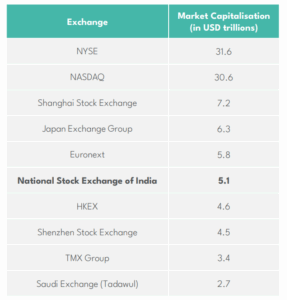
The National Stock Exchange of India (NSE) was incorporated in 1992. Trading began in 1994, with it later becoming the country’s pre-eminent stock exchange. Its market cap reached $5.1 trillion as of the end of 2024, placing it among the 10 largest stock exchanges globally.
Between them, the BSE and NSE are home to roughly 7,700 companies.
When it comes to selecting names for a portfolio, many investors opt to stick to an index. To put that into context, some of the most well-known Indian equity indices consist of between 30 and 500 names. This means the index at lower end of that range is comprised of less than 0.4% of all listed Indian companies, while the index at the upper end represents less than 6.5%.
For Mike Sell, Head of Global Emerging Market Equities, indices can be useful tools. “There are numerous index providers which provide a really useful service to investors. That work is not to be underestimated or undervalued. But indices are a tool, not a panacea. There are huge numbers of companies that are not included in the main Indian indices that should not be ignored by investors,” he adds. “The opportunity set is vast, especially for companies in the small to mid-cap range, which is why it can be hugely rewarding for investors to look beyond the obvious and venture outside the confines of a predetermined list.”
Among the limitations of sticking solely to an index is their tendency to reflect the more traditional industries of the past.
About half of the holdings in the Alquity Indian Subcontinent Fund are not in the main Indian indices. For Mike “it’s about using rigorous fundamental analysis and a disciplined investment approach to uncover hidden gems”.
WHAT MAKES A STOCK PICKER’S PARADISE?
The goal of any active manager is to identify mispriced securities that have the potential to deliver higher returns than the market, thereby generating better returns for investors.
One of the hallmarks of a good stock-picking environment is a resilient macro backdrop — where the economy is stable enough for company fundamentals to drive performance. “And this is the case with India… For example, it was well insulated against the tariffs announced by Donald Trump in early 2025, as such a small proportion of GDP is linked to US exports.”
“No country is entirely isolated from what is happening in the wider world; but a strong economy that is driven primarily by domestic, rather than global, factors creates a rich seam of opportunity for active managers”.
LEADERS AND LAGGARDS
Beyond a lower level of sensitivity to external forces, high return dispersion is also a core feature of a good stock picking market. A wide range of returns within a market increases the potential for active managers to pick winners and avoid laggards.
For Mike, this is where a robust investment process is vital. “It’s important to analyse why a particular company could outperform its peers. There will be several reasons for this; but the important thing to understand is whether it has stable and repeatable growth.”
OUT OF SYNC
Another key feature of a stock picker’s market is low correlation, where individual stock performance is driven less by broader, global macroeconomic factors, and more by company-specific fundamentals.
“Macroeconomic developments will always impact companies… There is no getting away from that. No active manager can, or should, ignore what is happening in the wider economy; but, to a greater or lesser extent, things such as changes to government policies will generally affect companies in similar ways.”
FUTURE WINNERS
True active managers, skilled stock pickers, relish markets that demonstrate high dispersion and low correlation because they are more likely to find mispriced opportunities.
“As an active manager, part of my drive, my passion for my work, is finding strongly growing and well-managed companies that have not yet been recognised. And India is a fantastic market in which to do that.”
“It’s size and scale are increasingly becoming recognised. It has one of the strongest predicted GDP growth rates in the world, according to the IMF. It has an ambitious government that has implemented a lot of business-positive reform over the past few years.”
The indices provide a snapshot of today’s winners. What the Alquity team is looking for is tomorrow’s winners.
SOURCES:
BSE, as of 2025, World Federation of Exchanges (as of 15th May 2025), BSE (as of 10th November 2025): NSE, as of March 2025, IMF, as of October 2025
India covers more than 3.2 million sq. km and, home to 1.46 billion people,
Read MoreFrom V-Mart’s Lalit Agarwal, who turned a family tailor shop into a 500-store fashion
Read MoreIt’s one of the biggest economies in the world, has one of the strongest
Read More
