It’s one of the biggest economies in the world, has one of the strongest projected GDP growth rates and is home to the largest population on Earth. Despite these credentials, it’s fair to say, at best, most investors have limited exposure to India.
Investors have long believed that putting their money to work in an emerging market or Asia fund is enough, but India is experiencing multiple tailwinds that are propelling its global ascendency and those with purely token exposure ought to reconsider.
For many years there has been talk that the 21st century will be India’s century, just as the 20th proved to be America’s, and the 19th is considered Britain’s. Whether this comes to pass or not, there remain many reasons investors need to be paying more attention to India.
India = growth
First and foremost, India is a growth story. In mid-2025, India became the world’s fourth largest economy after its GDP nudged ahead of Japan’s (see Table 1), according to the International Monetary Fund (IMF)(1).
By the end of this decade, the IMF is projecting that India will overtake Germany to become the third largest economy in the world, as it is on course to hit $6.77trn by 2030, compared with Germany’s forecast of $5.58trn(2).
Table 1
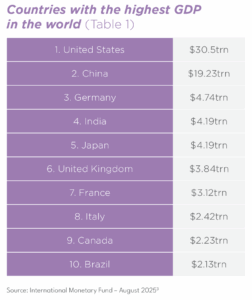
India is projected to achieve real GDP growth of 6.2% in 2025(4), which is the strongest among the countries listed in Table 1. Its closest competitor is China, which is forecast to achieve 4% growth(5).
Seven of the top 10 economies are on course to grow between 0.4% and 2% in 2025. The only outlier is Germany, which is not expected to record any real GDP growth(6).
India = ambition
In addition to the positive and improving economic outlook, Prime Minister Narendra Modi has outlined a series of ambitious targets. When India marks its centenary of independence in 2047, the goal is that the country will also be able to celebrate its elevation from emerging to developed market.
As such, in November 2023, his government unveiled Viksit Bharat(7) (Developed India), a declaration of intent to uplift all facets of India’s society and economy. The primary goal is for the country to become self-reliant and prosperous by 2047(8).
Growth is the game plan. To achieve the government’s ambitious GDP target of $30trn by 2047 – the current size of the US economy – India’s economy needs to grow more than seven-fold over the next two decades. This means, on average, GDP needs to rise by 8-10% every single year.
The social and economic reforms outlined by the Modi government are expected to be among the primary accelerators of this growth.
Steps have been announced to improve the ease of doing business in India, as well as greater support for micro, small and medium-sized enterprises (MSMEs) and startups(9).
Efforts have long been underway to help mostly small and rural businesses transition from the informal to the formal sector, as these companies are recognised as an essential and growing part of the Indian economy.
A successful transition means companies will be able to access finance and government support, as well as benefit from greater legal and regulatory protections(10). Workers will enjoy legal protections, like a fixed salary; healthcare benefits; paid leave; and retirement savings(11).
India = demographics
Equally important are the social reforms Modi’s government has outlined as part of Viksit Bharat. These include zero poverty, female empowerment, quality education and affordable and comprehensive healthcare.
In April 2023, India’s population reached 1.42bn, surpassing China to become the world’s most populous country. The UN estimates that the number of people in India will peak at around 1.7bn by the 2060s, whereas China’s population has already started to decline(12).
Importantly, India is home to a lot of young people. According to the US Central Intelligence Agency (CIA), as of 2024, the median age of India’s population was 29.8 years. This compares with 49.9 years for Japan, 46.8 in Germany, 40.2 years in China and 38.9 in the USA(13).
A young, healthy and well-educated population creates a virtuous circle of growth. It will result in a stronger workforce that is able to take on more high value jobs, which means higher wages, a larger middle class and even greater discretionary spending.
India = business
When investing in India, most fund managers turn to the MSCI for ideas and inspiration. Comprised of the large and mid-cap segments of the market, the MSCI India Index is made up of 158 companies, covers 85% of the Indian equity universe and falls into 11 broad sectors (see Chart 1)(14).
Chart 1

Investors, therefore, tend to be largely exposed to India via ETFs and funds that are dominated by large cap companies, which means they miss out on the opportunities available in the small cap space.
Indexes are also backwards looking, recognising the achievements of the past but not necessarily the growth opportunities of the future.
Research from McKinsey has identified 18 transformative ‘arenas’ in India (see Table 2) it believes ‘could experience significant growth, technological advancements, and sustained investment dynamics’(16).
The report stated: “Nine of these are global arenas where Indian companies could attain disproportionate growth through distinctly Indian capabilities. The other nine are what we define as ‘national’ arenas or sectors that could advance long-term strategic interests and fuel growth in a uniquely India-specific context.
“This mix of global and national arenas could play a pivotal role in realising India’s vision of becoming a developed economy by 2047,” the McKinsey report added(17).
Table 2
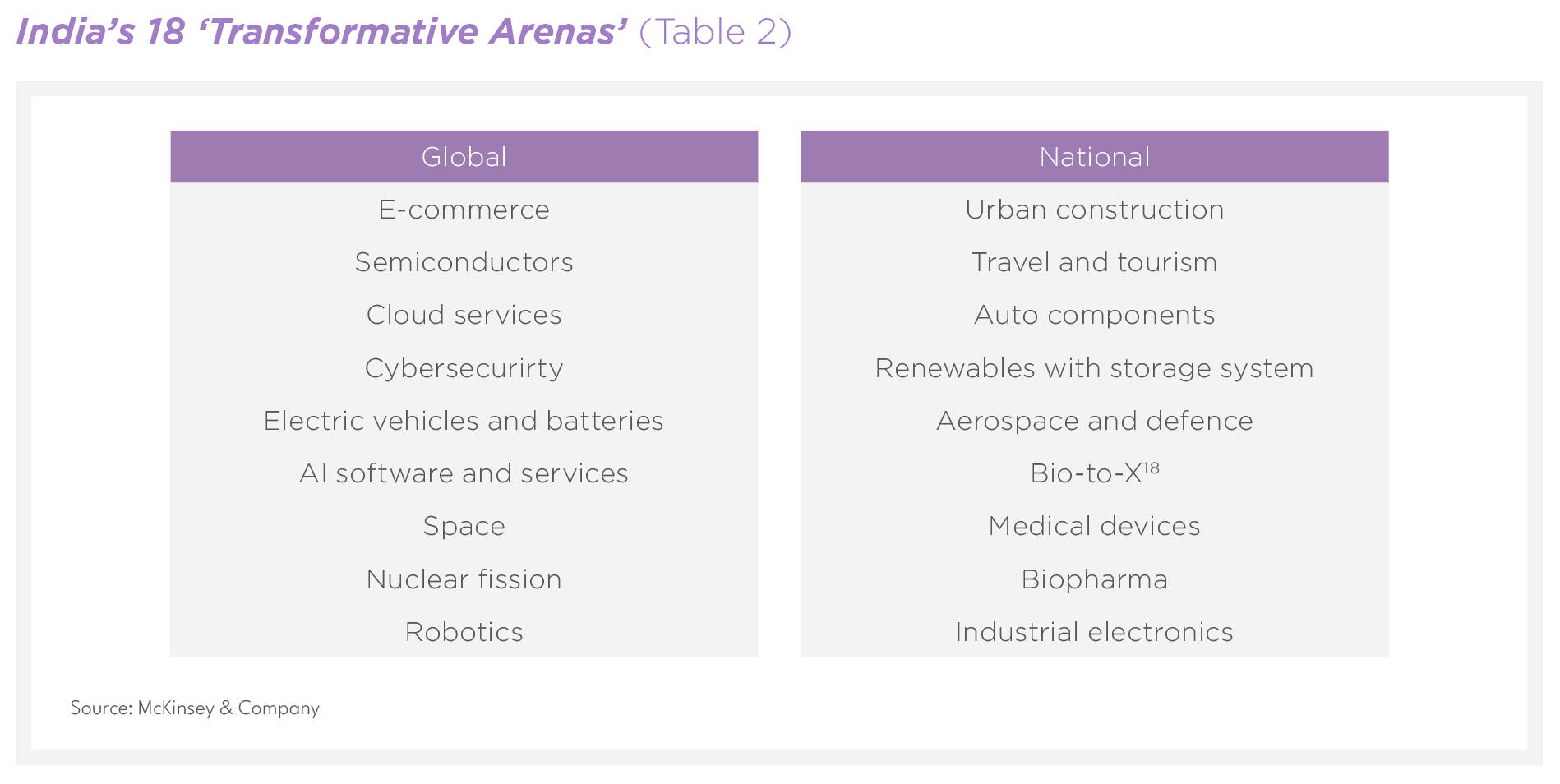
When compared with the (admittedly) broad categories included in the MSCI India Index (see Chart 1), the full extent of opportunities that investors risk missing out on becomes clear.
And there is no shortage of current and budding entrepreneurs in India. The 2024/25 Global Entrepreneurship Monitor, which assesses national levels of entrepreneurial activity each year, ranked India fifth out of 56 countries(19). It found that 85% of Indians are confident they have the skills or knowledge to start their own business. A similar proportion said they felt it was easy to start a business in India.
India = opportunity
Investors often have a myopic view of India. The 158 predominately large caps in the MSCI India Index overshadow the fast-growing and innovative smaller companies that are emerging each year.
India’s size, scale, population and strong growth don’t seem to generate the same level of international headlines as other countries.
But there are so many factors at play that all point to a bright future for India. It boasts a strong and growing economy, an increasingly well-educated and healthy population, and strong levels of entrepreneurship. All of this is backed by a stable government that has demonstrated how ambitious it is.
Investors need to take note. The Indian growth story is far from over.
Disclaimer:
This is not an offering memorandum or prospectus and does not constitute investment advice. This is a marketing communication that is intended for information purposes only. The content, including external data sources, is believed to be reliable but no assurances or warranties are given. The companies mentioned are shown for illustrative purposes only, do not constitute investment advice, and are not a recommendation to buy or sell any security.
Investments in emerging markets, including India, involve greater risks, including political, currency, and liquidity risks.
Prospective investors should read and understand the terms of the Prospectus (including the risk factors) prior to purchasing units in any of the funds. There can be no assurance that the fund’s investment objectives will be achieved and investment results may vary substantially over time. We do not provide financial, tax or legal advice and we recommend that you obtain your own independent advice tailored to your individual circumstances prior to investing. Prospective investors should be aware that the value of
investments can go down as well as up and past performance is not an indicator of future performance. Investors should be aware that by investing in the fund, they risk losing all or part of the capital invested. The Alquity Asia Fund, Alquity Future World Fund, Alquity Indian Subcontinent Fund and Alquity Global Impact Fund are sub-funds of the Alquity SICAV (the “Fund”), which is a UCITS-compliant investment vehicle and a recognised collective investment scheme under the Financial Services and Markets Act 2000 (FSMA) in the United Kingdom.
The Alquity SICAV is an open-ended investment company managed by Limestone Platform incorporated under the laws of Luxembourg and authorised by the Commission de Surveillance du Secteur Financier
(CSSF). The Fund is authorised under the UCITS Directive (Directive 2009/65/EC). Sub-funds may not be registered for distribution in all jurisdictions. Alquity Investment Management Limited acts as the investment manager to the SICAV.
This marketing communication is issued by Alquity Investment Management Limited (“AIML”) for distribution both within and outside the United Kingdom. AIML is incorporated in England and Wales (Company No. 07992381) and is authorised and regulated by the Financial Conduct Authority (FRN 463991). Its registered office is Audrey House, Ely Place, London, EC1N 6SN.
Sources:
- International Monetary Fund
- International Monetary Fund
- International Monetary Fund
- International Monetary Fund
- International Monetary Fund
- International Monetary Fund
- India’s Journey to Becoming a Global Superpower
- Meaning, Vision, Objective, Registration
- Bold Vision, Brighter Future
- Rethinking Formalization
- The Transition of India’s Economy Towards Formalization
- Department of Economic and Social Affairs
- CIA – Median age
- Blackrock – iShares MSCI India UCITS ETF
- India’s future arenas: Engines of growth and dynamism
- India’s future arenas: Engines of growth and dynamism
- India’s future arenas: Engines of growth and dynamism
- The so-called Bio-to-X market includes various sectors that exploit biological raw materials, such as biofuels and bioplastics
- Global Entrepreneurship Monitor