

 DOWNLOAD PDF REPORT
Despite the global surge in oil prices, Indian pump prices have barely moved – the country has returned to a period of ‘frozen’ retail prices to shield consumers from inflation, forcing the state-run oil marketing companies to absorb the difference. Government-controlled (but stock market listed) Indian Oil Corporation (IOC), Bharat Petroleum and Hindustan Petroleum control ~90% of India’s fuel retail market – and all three are expected to report huge losses. For example, Indian Oil’s adjusted quarterly net profit is expected to swing from 72bn INR a year ago to a projected 11.5bn INR loss this quarter*. This is not a new phenomenon. Whilst petrol pricing was formally deregulated in 2010, the government has consistently reasserted control over retail prices, particularly during politically sensitive periods such as elections. Prices have been held largely flat since April 2022 and, as we had expected, government intervention tends to be the norm rather than the exception.
This is structural, not a one-off
Indian Oil Corporation has posted record profits in recent years – discounted Russian crude, global refining capacity strains and artificially high retail fuel pricing created the perfect windfall. However, that advantage is now sharply reversing due to the Gulf crisis, leaving the company with soaring input costs that it cannot pass on to consumers.
The chart below shows the performance of IOC versus the broader market (Nifty 50) and we strongly believe that the decade-long relative underperformance is the underlying trend which we expect to persist, rather than the nearer term outperformance. 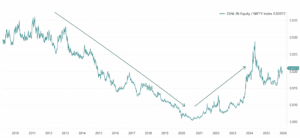
There is a historical precedent…
This pattern of state intervention is not an isolated episode, nor is it limited to just retail fuel pricing. SOEs regularly prioritise political or social goals rather than the interests of minority shareholders:
Thirty years of investing in India has taught us to be consistent on this point; while short-term stock rallies might look appealing, the risks of SOE investing have a persistent habit of reasserting themselves eventually.
Alquity’s approach to SOEs and Governance
At Alquity, we assess every potential investment through our rigorous ESG screening process. SOEs routinely fail our standards of governance – companies must be demonstrably run in the interests of minority shareholders, with rigorous checks and balances to prevent abuse. We invest in India for its extraordinary private sector dynamism: world-class entrepreneurs, leading businesses and management teams whose interests are aligned with ours.
SOURCES:
Alquity, Bloomberg, as of April 2026. *Source: Elara Capital, as of April 2026.
India covers more than 3.2 million sq. km and, home to 1.46 billion people,
Read MoreFrom V-Mart’s Lalit Agarwal, who turned a family tailor shop into a 500-store fashion
Read MoreIt’s one of the biggest economies in the world, has one of the strongest
Read More
