VAM Multi-Asset Funds Market Outlook – October 2026
From cuts to hikes: interest-rate expectations shift sharply
Investors began 2026 expecting interest rates to fall. By September, stronger-than-expected growth and persistent inflation had forced central banks to rethink the path ahead. Renewed expectations of rate hikes caused bond yields to rise sharply, which put pressure on bond prices (when yields rise the price of existing bonds fall) particularly in the US, where bond yields rose most noticeably.
Global equities, however, remained resilient, supported by strong earnings expectations and continued optimism around artificial intelligence, although performance varied considerably across sectors and regions.
So why have expectations changed, and what does it mean for your investments?
Markets move from expecting cuts to anticipating further increases
A stronger economy sounds like good news, and in many ways it is. When consumers keep spending and businesses keep investing, companies have more opportunity to grow their profits. But strong demand can also keep prices rising, making it harder for central banks to bring inflation under control.
At the start of the year, investors expected the Federal Reserve (“the Fed”) to cut interest rates two or three times. Instead, September brought a rate increase, its first in more than three years. Fed Chair Kevin Warsh’s speech at the Jackson Hole symposium helped signal the change, putting inflation risks firmly back in the spotlight.
The US economy has remained resilient. Businesses are spending heavily on AI infrastructure, government spending continues to support activity, and consumers have kept buying. The jobs market, previously seen as a potential weak spot, has also held up relatively well. Together, these forces have given the economy momentum, but most importantly inflation has been persistently stubborn.
The conflict in the Middle East and its effect on energy prices has added to the inflation challenge. There remains considerable uncertainty around how the conflict will develop, but oil exports from the Gulf have begun to recover. Weaker demand from major importers such as China, combined with increased production elsewhere, is helping the global market absorb much of the lost supply. However, the risk of higher oil prices has not gone away. A further escalation that causes a large and sustained increase in oil prices would place additional pressure on consumers and businesses, while making central banks more concerned about inflation. For now, however, oil prices have remained below their earlier highs, and markets expect them to decline gradually over time.
The shift in the expected path of interest rates has not been confined to the US, as a similar change has occurred closer to home. The European Central Bank has increased rates twice this year, despite markets beginning 2026 expecting no change. In the UK, markets have moved from expecting one or two cuts to anticipating four Bank of England rate increases over the coming year.
There is an important difference, however. The UK and eurozone face more challenging growth outlooks than the US. This raises the question of whether their economies will ultimately require all the interest-rate increases currently expected by markets.
Bond markets adjust to higher interest rates
The change in policy rate expectations pushed government bond yields higher during September. US Treasury yields moved more than the UK, with the US 10-year yield rising by around half a percentage point. Because bond prices fall when yields rise, this created a difficult month for government bond investors.
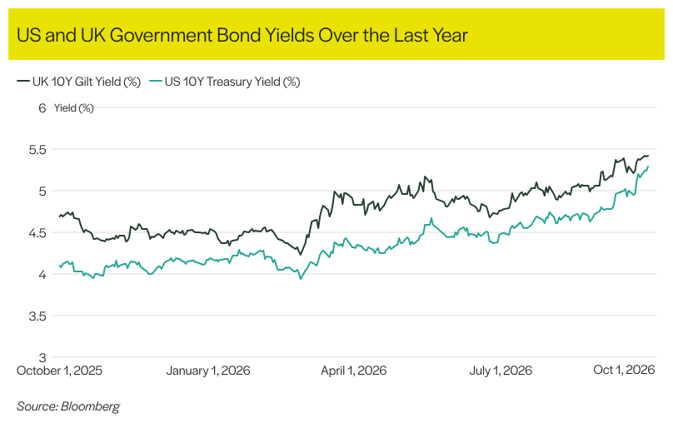
UK gilt yields also rose materially, reflecting the Bank of England’s increasing focus on inflation, despite a minority of policymakers voting to raise rates at its September meeting. The UK economy faces weaker growth, a softer labour market and less supportive consumer conditions than the US. Therefore, if inflation pressures ease, the investment team at atomos believes the Bank of England is likely to keep rates lower than markets expect, leading to stronger returns for UK government bonds. The team therefore continues to see gilts as attractive relative to several other major government bond markets. The chart herewith shows the change in US and UK bond yields over the last year.
Attention is now turning to the Autumn Budget. The investment team at atomos expects the Government to reaffirm its commitment to the fiscal rules and maintain meaningful fiscal headroom, limiting the risk of lasting volatility in gilts or Sterling. However, the detail will matter. If near-term spending rises without corresponding tax increases or a credible funding plan, investors are likely to demand higher returns for lending to the Government – implying higher government bond yields, placing renewed pressure on gilt prices and Sterling.
Equities prove resilient despite rising yields
Historically, a large increase in bond yields would be expected to create a significant headwind for equities. At the headline level, however, global equities weathered this increase well. Beneath the surface, there were considerable differences. Several sectors struggled with higher borrowing costs and energy prices, while technology and communication services companies performed more strongly.
Continued investment in AI remained an important source of support. Companies are still committing significant sums to data centres, semiconductors, and computing capacity, while expectations for technology-sector profits remain strong.
This does not mean higher interest rates are unimportant. Fast-growing companies often derive much of their value from profits investors expect them to generate many years from now. Their share prices can therefore be particularly sensitive to changes in interest rates and growth expectations.
For now, continued investment and strong earnings expectations have provided an important counterweight. Outside the US, equity returns were generally weaker, reflecting less exposure to the AI investment theme and, in parts of Europe, greater sensitivity to energy prices. Even so, losses remained relatively contained given the difficult backdrop.
What does this mean for investors?
September showed how the same economic news can affect investments differently. Strong growth made interest-rate cuts less likely, hurting bond prices, while also supporting the profit expectations that helped equities hold their ground.
The investment team at atomos continues to see opportunities across both equities and bonds. Higher yields have improved the returns available from government bonds, with UK gilts looking particularly attractive as markets may be pricing in more UK interest-rate increases than the economy ultimately requires, meaning yields could fall if expectations for future rate rises are scaled back. For equities, resilient company earnings and continued investment in AI remain supportive, although performance is likely to vary between companies, sectors and regions. This makes it important to look beyond the headline market figures and focus on where the underlying opportunities lie.
For long-term investors, the message remains unchanged. Maintaining a diversified portfolio and remaining focused on long-term fundamentals continue to be the most effective way to navigate periods of uncertainty.
Stock highlight of the month: Meta Platforms
Meta Platforms owns some of the world’s most widely used apps, including Facebook, Instagram, WhatsApp, Messenger and Threads. On average, 3.6 billion people use at least one of its apps every day. Almost all of its revenue comes from advertising, and its strength lies in the scale of its audience and the data that helps advertisers reach the right customers. Second-quarter revenue rose 28% to $60.8 billion, helped by artificial intelligence (AI) tools that improve how content and adverts are recommended.

Meta shares rose 27% in September, their strongest month since November 2022, outpacing the wider US equity market. The catalyst was the early September launch of Muse, a personal AI agent that can carry out everyday tasks on a user’s behalf, such as sending emails, booking travel and making purchases. Powered by Meta’s Muse Spark model, the app quickly overtook OpenAI’s ChatGPT as the top free app on Apple’s US App Store. Meta followed this with new features at its annual Connect conference and a push into business customers, including a version of Muse for small businesses.
The launch raised optimism that Meta can turn its heavy AI investment into products people want to use, opening potential new revenue streams beyond advertising. It is still early, and Meta has yet to show how it will make money from Muse, but this strong start positions it well to gain share against competitors in consumer AI.
Sign Up for our Newsletter
IMPORTANT – PLEASE READ
Source: atomos.
Information correct as of 2nd of October 2026.
FOR PROFESSIONAL INVESTORS ONLY.
atomos is the trading name of both Atomos Investments Limited (FCA No: 122588, Company No: 2041819) and Atomos Financial Planning Limited (FCA No: 193503, Company No: 3879955), both authorised and regulated by the Financial Conduct Authority and registered in England and Wales. Registered offices: 2nd floor, 5 Hatfields (alto), London, SE1 9PG.
The information and opinion contained in this article should not be treated as a forecast, research or advice to buy or sell any particular investment or to adopt any investment strategy. Any views expressed are based on information received from a variety of sources which we believe to be reliable, but are not guaranteed as to accuracy or completeness by atomos. Any expressions of opinion are subject to change without notice. Past performance is not a reliable indicator of future results. Investing involves risk and the value of investments, and the income from them, may fall as well as rise and is not guaranteed. Investors may not get back the original amount invested.
The companies mentioned are shown for illustrative purposes only, do not constitute investment advice, and are not a recommendation to buy or sell any security.
Read Important Information for Singapore Investors.
Disclaimer.
This is a marketing communication. This document is intended for use by professional financial advisers only. The distribution of VAM and Alquity Funds and the offering of the shares may be restricted in certain jurisdictions. Private investors should contact their financial adviser for more details on any of the products featured. It is the responsibility of any person in possession of this document to inform themselves of, and to observe, all applicable laws and regulations of any relevant jurisdictions. Prospective applicants for shares should inform themselves as to the legal requirements and consequences of applying for, holding and disposing of shares and any applicable exchange control regulations and taxes in the countries of their respective citizenship, residence or domicile. Read Full Disclaimer