VAM Multi-Asset Funds Market Outlook – August 2026 Smooth Sailing through a Semiconductor Storm
Despite volatility beneath the surface, broad markets have remained resilient
July provided another reminder that headline market performance does not always tell the full story.
At first glance, it looked like another relatively steady month for investors, as the global stock market remained resilient. Yet, beneath the surface, it was a very different story; individual companies, sectors, and regional markets experienced much larger swings. Despite the internal volatility, strong company earnings and continued optimism around artificial intelligence (AI) helped support overall market performance, even as some of the market’s biggest winners experienced sharp pullbacks.
At the same time, renewed tensions between the US and Iran led to heightened volatility in oil prices, while central banks continued to signal that interest rates may remain higher for longer.
Together, these factors created a more volatile environment, but one in which diversification again helped to cushion the effect on portfolios.

US-Iran tensions return, but oil markets remain adaptable
Hopes that June’s temporary easing in tensions between the US and Iran could lead to a more lasting agreement faded during July (though appear to be back on the table at time of writing). Shipping through the Strait of Hormuz (SoH), one of the world’s most important energy routes, had started to recover. However, renewed hostilities and restrictions on Iranian oil exports caused shipping activity through the SoH to fall sharply, pushing oil prices higher and increasing volatility. Towards the end of the month, a pause in military strikes offered some relief, although no formal settlement had been agreed and shipping remained well below normal levels.
Importantly, the investment team at atomos notes that oil flows through the SoH may not need to return fully to pre-conflict levels for prices to move back towards $70 a barrel. Several supply-and-demand factors can help absorb part of the disruption:
- Some large importers, most notably China, have been importing less oil
- Releases from strategic reserves have added to global supply
- Producers outside the Gulf, particularly in the Atlantic Basin, have increased exports
- The oil market entered the conflict with supply already exceeding demand
Over time, the disruption is also likely to encourage investment in pipelines and alternative export routes that reduce reliance on the SoH.
While a prolonged conflict remains a risk, particularly if higher oil prices feed through into inflation, the investment team’s central expectation is that the disruption is unlikely to have a lasting impact on global growth or financial markets.
Strong earnings offset AI-related volatility
Against this backdrop, company earnings remained an important source of support for equity markets. The second-quarter US earnings season was particularly strong. By the end of July, just over 60% of the largest US companies had reported, with 86% delivering profits above expectations. Overall earnings growth remained exceptionally strong.
Technology companies also continued investing heavily in AI infrastructure, including data centres, chips and computing capacity. While businesses remain confident in AI’s long-term potential, investors are increasingly asking a different question: will all this investment translate into meaningful profits in the long term?
Technology outperforming amid conflict
Last month, the investment team at atomos discussed how fast-growing companies, particularly those linked to AI, can experience larger swings in their share prices than the broader market. That was evident in July, as some of the companies and markets that had previously benefited most from excitement around AI gave back some of their earlier gains. Semiconductor shares fell, pulling several Asian markets lower. South Korea was particularly affected because a small number of large chipmakers make up a significant share of its stock market.
The chart herewith visualises this, comparing the year-to-date performance of South Korean and global equities.
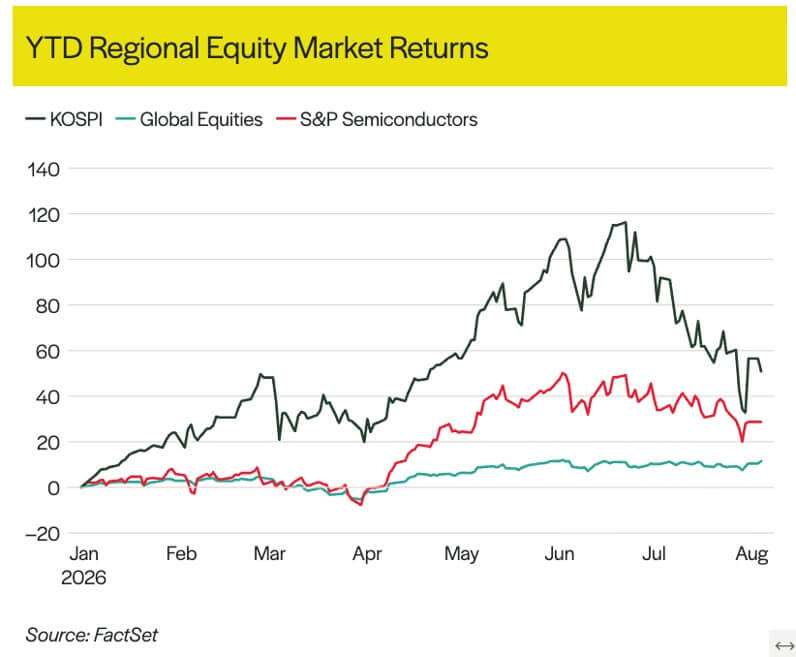
Essentially, the same concentration in AI related stocks that supported the market’s earlier rise magnified its subsequent decline in July.
The volatility reflects several related dynamics:
- Many AI-related shares entered July after exceptionally strong gains, leaving them sensitive to even modest changes in expectations
- Investors are constantly trying to assess how quickly heavy spending on AI infrastructure will translate into future profits, and for how long
- Concerns around increasing competition within parts of the semiconductor industry, alongside questions about future AI-related demand, added to pressure on some major Asian chipmakers
- When many investors hold similar positions, a change in sentiment can be amplified as they reduce exposure at the same time
The sharp moves under the surface illustrate that major technological transitions rarely progress in a straight line and that the eventual winners can change as a technology develops. Despite these large moves beneath the surface, broader global and US equity indices were considerably more stable, reinforcing the value of holding a balance of regions, sectors and investment styles.
Interest rates and UK politics remain in focus
The US Federal Reserve left interest rates unchanged in July, although the decision was not unanimous, with three policymakers voting in favour of an immediate rate increase. This highlighted that inflation remains a concern for some members of the committee, even as recent data has shown signs of improvement. Markets focused less on the decision itself and more on comments from Chair Kevin Warsh, who is evolving the Fed’s communication style towards a place where less guidance is provided on their expected future path of rates than investors had become used to. Combined with ongoing government borrowing, resilient economic growth and strong investment spending, this contributed to a move higher in long-term bond yields during the month.
In the UK, Andy Burnham became Prime Minister on 20 July. Financial markets reacted relatively calmly, with John Healy seen as a safe pair of hands for the Treasury, and with both the PM and the Chancellor re-affirming their commitment to keeping to the established fiscal rules. While the new leadership’s full policy agenda isn’t yet clear, and there may be episodic heightened volatility, the investment team ultimately doesn’t expect political and policy developments to exert sustained negative impact on gilt and Sterling markets.
What does this mean for investors?
July brought a renewed rise in geopolitical uncertainty and substantial equity market falls in certain sectors and geographies. However, at the same time, broad equity markets remained resilient, company earnings were strong, and investment linked to AI continued to grow and a strong pace.
For long-term investors, the main lesson is not to try to predict every market turning point. Chasing areas that have recently performed best, or selling after a sharp decline, can leave portfolios exposed to losses over time. A diversified portfolio, spread across regions, sectors and investment styles, remains one of the most effective ways to navigate this environment while retaining exposure to long-term opportunities.
Stock highlight of the month: SAP
SAP, Europe’s largest software company, is a global leader in enterprise resource planning (ERP) – the software businesses rely on to manage finance, supply chains and human resources. Having built its business on traditional on-premises software, SAP is well into its transition to the cloud, moving customers onto subscription-based products ahead of the 2027 end of support for its legacy ECC system.
That transition has continued to make good operational progress, but shares traded lower through much of the year as investors questioned whether advances in artificial intelligence could disrupt SAP’s core business. The investment team at atomos viewed those concerns as overdone and added the company to the portfolio in late June. The latest results validated that thesis, reinforcing its conviction that SAP’s cloud migration should strengthen the business over time, and that its deeply embedded software remains critical infrastructure that customers find both costly and difficult to replace.

The results also arrived at an opportune moment, as investor sentiment towards software companies improved and markets increasingly favoured durable, recurring revenue over more cyclical areas of technology. SAP’s scale and the data embedded within its software create high switching costs, while its investment in AI is enhancing rather than threatening its competitive position. By embedding AI capabilities directly into its core applications, SAP is making its products more valuable and further strengthening customer relationships, supporting the investment team’s belief that the market has misidentified SAP as an AI loser.
Sign Up for our Newsletter
IMPORTANT – PLEASE READ
Source: atomos.
Information correct as of 5th August 2026 and does not account for subsequent developments in the Middle East.
FOR PROFESSIONAL INVESTORS ONLY.
atomos is the trading name of both Atomos Investments Limited (FCA No: 122588, Company No: 2041819) and Atomos Financial Planning Limited (FCA No: 193503, Company No: 3879955), both authorised and regulated by the Financial Conduct Authority and registered in England and Wales. Registered offices: 2nd floor, 5 Hatfields (alto), London, SE1 9PG.
The information and opinion contained in this article should not be treated as a forecast, research or advice to buy or sell any particular investment or to adopt any investment strategy. Any views expressed are based on information received from a variety of sources which we believe to be reliable, but are not guaranteed as to accuracy or completeness by atomos. Any expressions of opinion are subject to change without notice. Past performance is not a reliable indicator of future results. Investing involves risk and the value of investments, and the income from them, may fall as well as rise and is not guaranteed. Investors may not get back the original amount invested.
The companies mentioned are shown for illustrative purposes only, do not constitute investment advice, and are not a recommendation to buy or sell any security.
Read Important Information for Singapore Investors.
Disclaimer.
This is a marketing communication. This document is intended for use by professional financial advisers only. The distribution of VAM Funds and the offering of the shares may be restricted in certain jurisdictions. Private investors should contact their financial adviser for more details on any of the products featured. It is the responsibility of any person in possession of this document to inform themselves of, and to observe, all applicable laws and regulations of any relevant jurisdictions. Prospective applicants for shares should inform themselves as to the legal requirements and consequences of applying for, holding and disposing of shares and any applicable exchange control regulations and taxes in the countries of their respective citizenship, residence or domicile. Read Full Disclaimer